Please choose your photo size from the drop down menu below.
If you wish your photo to be framed please select Yes.
Note: 16″x 20″not available in a frame.
Images can also be added to accessories. To order please follow these links

£8.95 – £49.95Price range: £8.95 through £49.95
Please choose your photo size from the drop down menu below.
If you wish your photo to be framed please select Yes.
Note: 16″x 20″not available in a frame.
Images can also be added to accessories. To order please follow these links
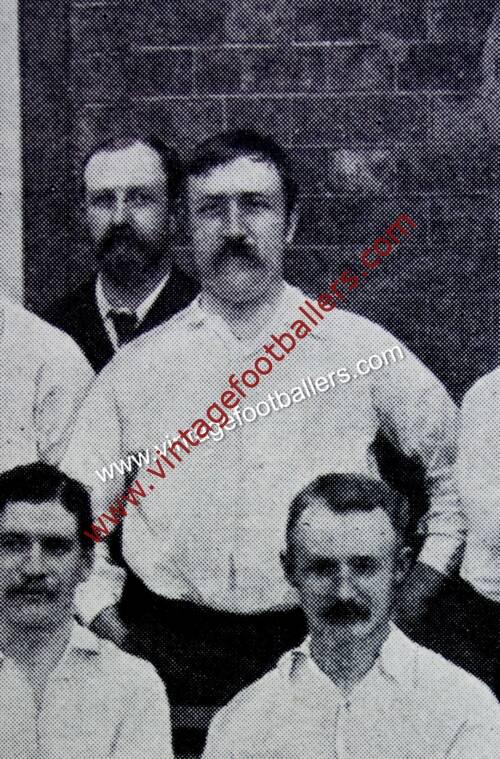
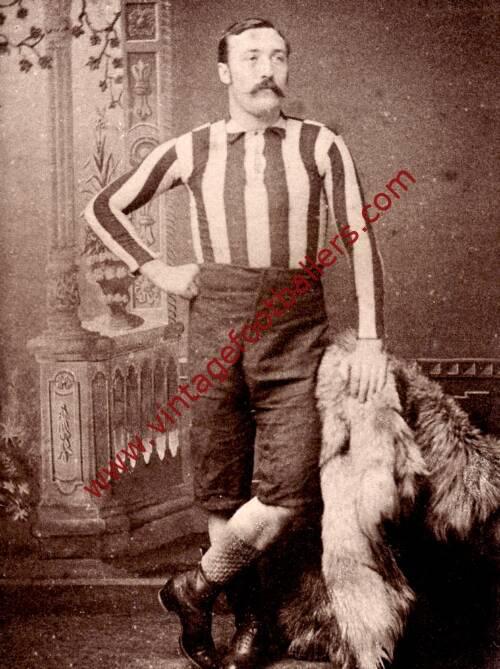
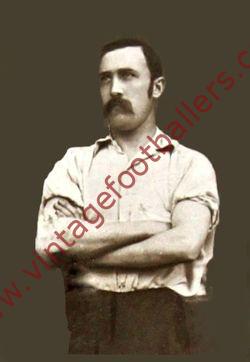
Ayr born wing half Johnny Graham had started his professional football career in 1883 with Annbank and while playing for them won a single cap for Scotland when he was selected in a 5-0 win over Ireland at Ballynafeigh Park in Belfast in January 1884.
He was one of the many Scottish footballers who joined Preston North End in the mid-1880’s as the Lancashire club assembled a side that was almost unbeatable. Graham was in the Preston side that were 1888 FA Cup Finalists, losing to West Bromwich Albion, and the following season he played for Preston as they did The Double, becoming the inaugural Football League Champions and 1889 FA Cup Winners, beating Wolves 3-0 in the Final.
During the 1888-89 season his brother William also played for Preston, but the following season his football career was ended when he suffered a broken collarbone in a match having played 17 games in a season that Preston also won the League Championship. In total he made 44 appearances, excluding appearances prior to the Football League era.
NB written by Preston North End historian Martin Atherton:
Johnnie and Willie Graham were born nine years apart. Johnnie was the only regular member of the Preston North End Invincibles side to be born in the 1850s and so he was very much the role model for his younger team-mates to emulate. He was the youngest of eight surviving children, with his older brother George being a year older and born when their father was only 16. By the time he was 20, John Graham senior had at least three children, so home life must have been very busy in 1871 with eight children under 16. Johnnie started out as a footballer with Lanemark FC, who were formed by employees of the Lanemark Colliery in New Cumnock, where the Graham family were now living. In fact, Lanemark’s ground was right in front of his home in Connel Park. Johnnie’s stocky miner’s build was deceptive, as he won many medals as a young man for his running ability at distances up to a mile and he had a decent turn of speed to complement his physical strength. It is not surprising to learn his early days were spent at centre forward, given these attributes and he spent time with Kilmarnock Portland, where he attracted the attention of the famous Third Lanark club in Glasgow. He soon moved on again without playing in Third’s first team, joining Annbank who – although they were based in a small mining village near Ayr – were a well-respected side in Scotland in the early 1880s. Whilst there, Johnnie was capped by Scotland versus Ireland in his country’s first ever British Championship match, which they won in Belfast by 5-0. By this time, he had converted to half-back (midfielder in modern parlance) and he spent the rest of his career there. By the time he joined Preston North End, he was therefore a seasoned player who brought maturity to the younger members of the team. He formed a half back line alongside fellow Ayrshire men Davie Russell and Sandy Robertson, where he was known for his tackling ability, powerful headers and a long throw that resulted in many goals – yet another reminder that there is nothing new in football tactics or skills.
While at Deepdale, Johnnie was selected to represent Lancashire County on several occasions, to add to the caps he had won with Ayrshire and he was also picked for the Players XI in their matches against their amateur Gentlemen counterparts. He appeared in at least 245 games for North End prior to the Football League starting in September 1888s, including a Lancashire Cup final, two FA Cup semi-finals and one final as well as his various representative matches. Johnnie’s reliability continued into the Double season, as he turned out in all 22 league games and five FA Cup ties, together with numerous friendly matches. Although he did not score in those matches, this was neither his main job nor necessary given the attacking talent in the team and he was fully worthy of his reputation as an Invincible. Given his games prior to the start of the Football League, he played well over 300 games for the club in only six years – a model of consistency and a central part of the team for more than just the Double season. He missed one of the first 17 games of the following league season up to Boxing Day, 1889, as North End retained their title, but his career as a professional footballer was effectively ended by a broken collarbone, sustained in a friendly match against the Corinthians. He made one final appearance in March 1890 but he was unable to continue playing. He returned to Scotland and the 1891 census shows him back living with his parents in New Cumnock, where once again he was working as a miner. It seems somewhat ironic that despite a broken collarbone ending his football career, he was still able to perform the physically demanding job of a coalminer. His wife and three children were also in New Cumnock but living at a separate address at Bank Glen Cottages. There is evidence to suggest Johnnie returned to Annbank FC after returning to New Cumnock and appeared in the 1893 Ayrshire Cup final on the winning side as Annbank beat Kilbirnie 5-2. He made one final appearance at Deepdale in 1900, when he was part of the ‘Old Invincibles’ that played in Geordie Drummond’s testimonial match and featured many of his former team-mates. The 1901 census shows the family back together ten years later, now comprising Johnnie, Jane and their four children but Jane died two years later aged 40. Johnnie had a daughter Marion with 19 year old Mary McLean in 1905 and they married in 1908. When attending the 1922 FA Cup final between North End and Huddersfield, he revealed he was living with cancer and his former club and team-mates helped fund his care for the remainder of his life. He died in 1927 on his 70th birthday, fondly remembered by all who saw the father figure of the Invincibles play for Preston North End.
Johnnie’s younger brother Willie had a much less exalted career with Preston North End but he still contributed to the success of the Double season and therefore deserves to be regarded as an Invincible. He might be thought to have timed his arrival to perfection, as he signed for North End in August 1888, immediately prior to the Football League beginning in September. His football to that time had been with local side New Cumnock, so his brother Johnnie may have been instrumental in Willie signing for North End. The 1881 census showed him as one of ten children living with his parents; given that Johnnie and George had left home by that point, the Graham brothers must have been two of at least 12 siblings. In keeping with the rest of the family and the community in which they lived, Willie was shown as a 15 year old miner – an occupation he returned to once his playing day were over, just as his brother did.
To some extent, Willie owed his presence in three of Preston’s first four league fixtures to Davie Russell’s music hall career so Willie – also a centre half – found himself playing in the opening day defeat of Burnley and then the victory at Wolverhampton. Willie was to make only two further appearances in November but all five games for the Invincibles ended in victory, with a goal tally of 18-6 so he certainly contributed to the club’s league champion success. During this time, he also played in 11 of the 12 friendlies North End undertook alongside their league commitments so he was clearly highly thought of at Deepdale. He left North End in summer 1889 but remained in Preston, having married Agnes Kelly earlier that year. Their son John was born the following year and Willie moved his family back to New Cumnock, where they set up home at 72 Connel Park. He returned to mining and rejoined his local football team before signing for Northern League side Newcastle East End in 1892, who soon merged with Newcastle West End to form Newcastle United. He returned to the Football League with United in 1893 and played 98 times before leaving in 1896 after a dispute over money. During his time with Newcastle United, he appeared in the new club’s first ever game at St James’s Park in 1892, when his teammates include two former Lanemark FC players, Thomas Crate and Joseph Wallace. While there, he was yet another of the Invincibles team to become a pub landlord in 1894 but the family eventually returned yet again to New Cumnock following his final game for Newcastle in September 1896 and Willie assumed the life of a miner for the third time. He also rejoined the ranks of Lanemark FC in 1898, returning to the starting place of his footballing adventure. The 1901 Scottish census shows him living in New Cumnock with his widowed mother, his wife Agnes lived separately in Old Cumnock with their six children, one of who had been born during Willie’s time with Newcastle. Whether this was for practical reasons or due to estrangement is not known, although their youngest child had only been born two months previously. Willie outlived his brother by ten years, dying in 1937, aged 71.
| Weight | N/A |
|---|